

Types of Corkscrews: 8 Wine Openers and How They Work Leave a comment
Types of corkscrews, short answer: there are six common manual types (the waiter’s friend, the winged corkscrew, the T-handle, the lever or rabbit corkscrew, the two-prong cork puller and the continuous-turn corkscrew), plus two wine openers that skip the manual pull: electric openers and air-pressure openers. All of them get a cork out, but they ask for different amounts of skill, effort and drawer space. Below: how each one works, its pros and cons, who it suits, and which to choose or give.
The short version
The least effort of any type of corkscrew
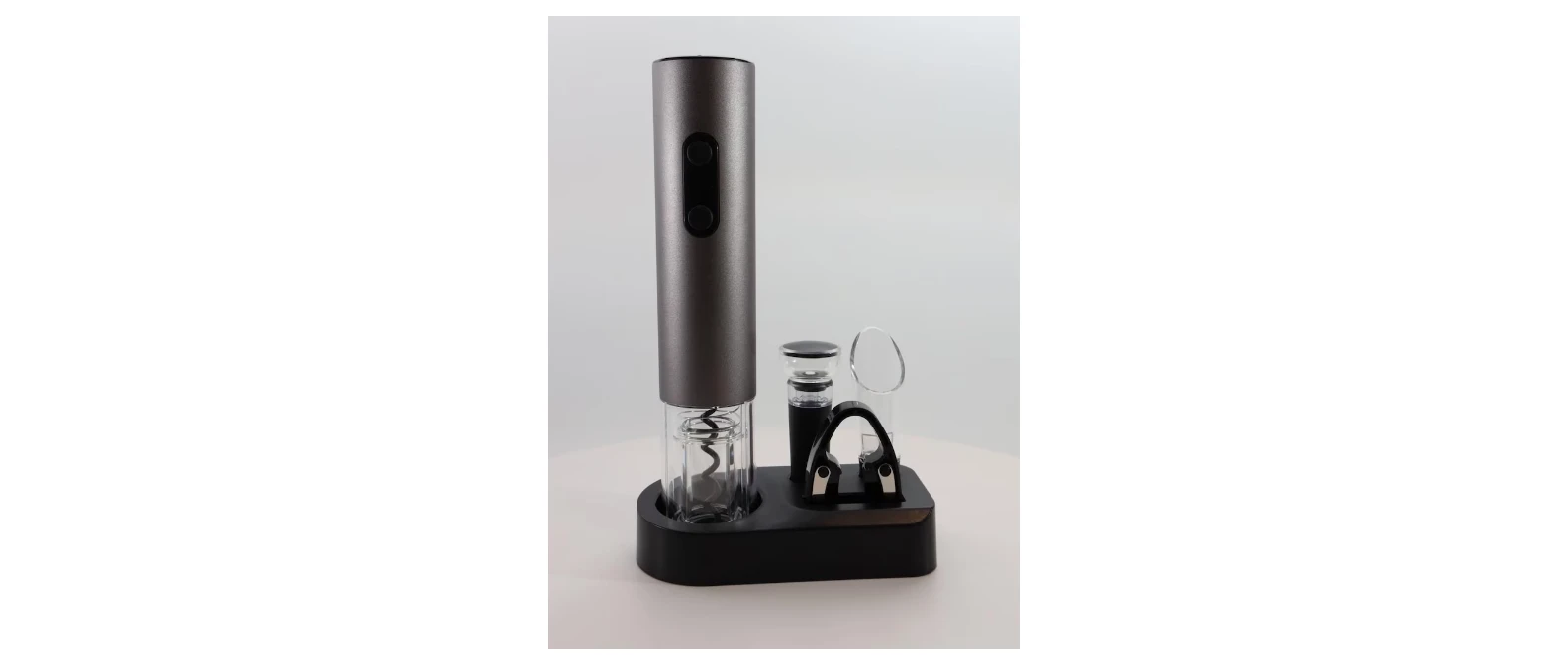
Personalized Electric Wine Opener Set: opener, foil cutter, stopper and pourer on one stand
What are the main types of corkscrews?
Every corkscrew shares one part: a spiral, called the worm, that twists into the cork. What changes is how the cork comes back out. Two kinds of wine opener skip the spiral altogether. The Wikipedia entry on the corkscrew covers its history; the table below is the practical version.
| Type | How it works | Effort | Best for |
|---|---|---|---|
| Waiter’s friend | Worm twists in; a hinged lever on the bottle lip lifts the cork | Medium | Everyday use, carrying with you |
| Winged | A frame centers the worm; pressing two arms down lifts the cork | Low to medium | Occasional use, beginners |
| T-handle | Worm twists in; you pull the cork straight out | High | Picnics, a backup tool |
| Lever (rabbit) | Clamps on the neck; one lever stroke drives the worm and draws the cork | Low | Hosts opening several bottles |
| Two-prong (ah-so) | Two thin blades slide between cork and glass; twist and pull | Medium, needs practice | Old or fragile corks |
| Continuous-turn | Turn one way; the worm goes in, then the cork rides up | Low | A weaker grip |
| Electric | Press a button; the opener drives the worm and lifts the cork | Very low | Hosts, stiff hands, gifts |
| Air-pressure | A needle goes through the cork; air pressure pushes it up | Low | Still wines, compact storage |
Check the closure before you reach for any of them. Many wines are sealed with a screw cap and need no tool. Corked bottles use either natural cork, cut from the bark of the cork oak, or a synthetic cork, which tends to feel tighter going in and coming out.
Waiter’s friend: the sommelier’s corkscrew
The waiter’s friend, also called a sommelier knife, is a folding pocket tool with a small foil blade, a worm and a lever arm. You twist the worm in, rest the lever on the lip of the bottle and lift the handle. A single-hinged lever pulls the cork in one long motion. A double-hinged model has two steps, lifting the cork halfway and then the rest, which takes less force and keeps the cork straighter. Buy the double-hinged one.
- Pros: compact, inexpensive, includes a foil knife, works on most corks.
- Cons: takes a few bottles to learn and still needs some grip.
- Best for: anyone who opens wine regularly and wants one tool that goes everywhere.
Winged corkscrew: easy to learn, bulky to store
A winged corkscrew has a frame that sits over the neck and centers the worm on the cork. As you turn the top handle, the worm goes in and two arms rise on either side. Push both arms down and the cork lifts out.
- Pros: intuitive, keeps the worm centered, needs little skill.
- Cons: bulky, and cheaper versions often use a thick, drill-like screw that can tear dry corks.
- Best for: occasional wine drinkers and anyone who never got the hang of a waiter’s friend.
T-handle corkscrew: the simplest design
The T-handle, or direct-pull, corkscrew is a worm fixed to a handle and nothing else. You screw it in and pull the cork out with your arm.
- Pros: cheap, nothing to break, fits anywhere.
- Cons: the most effort of any type, and a tight cork can come out with a jerk and a splash.
- Best for: a picnic basket or a backup in the drawer.
Lever corkscrew: the fastest manual type
A lever corkscrew, often called a rabbit-style opener after the shape of its handles, clamps onto the neck. Push the long lever down to drive the worm in, pull it back up to draw the cork, then repeat the motion to slide the cork off the worm.
- Pros: fast, low effort, consistent.
- Cons: large, costs more than other manual types, more moving parts.
- Best for: people who open several bottles at a time.
Two-prong cork puller: the tool for old corks
The two-prong cork puller, often called an ah-so, has no screw. Two thin, flat blades of different lengths slide down between the cork and the glass. Rock them in gently, one side at a time, then twist and pull. Nothing pierces the cork, so it handles old, dry or fragile corks that a worm would crumble.
- Pros: no hole in the cork, which can go back in the bottle.
- Cons: takes practice, can push a loose cork into the wine, struggles with tight synthetic corks.
- Best for: anyone opening older bottles, with a waiter’s friend kept as backup.
Continuous-turn corkscrew: keep turning, the cork comes up
A continuous-turn corkscrew, the screwpull style, sits on the bottle in a frame. You turn the handle one way only: the worm goes into the cork, and once it can go no further, more turning draws the cork up and out. Many have a long, coated worm that slides through the cork easily.
- Pros: very little pulling force, the worm stays centered.
- Cons: bulkier than a pocket tool, and the coating on the worm can wear over time.
- Best for: a weaker grip, when you still want a manual tool.
Electric wine opener: one button, no pulling
An electric wine opener works like a continuous-turn corkscrew that turns itself. Cut the foil, set the opener on the neck and press the button: the worm goes in and lifts the cork, and a second press releases it.
- Pros: the least effort of any type, no technique, easy for guests to use.
- Cons: costs more than a manual tool, takes counter space, still needs a foil cutter.
- Best for: hosts, and anyone with stiff hands or a weak grip.
Other guides go further. What to look for is in our guide to the best electric wine opener, the head-to-head is in electric vs manual wine openers, and the step-by-step, including a stalled cork, is in how to use an electric wine opener.

The easiest type, set up as a gift
Personalized Electric Wine Opener Set
- Electric opener, foil cutter, wine stopper and pourer on one stand
- Brushed stainless steel or dark aluminum alloy
- Engraved with a name, initials or a short message (+$5)
Engraved to order · Fast USA shipping · Gift wrapping available
Air-pressure wine opener: a needle and a pump
An air-pressure opener pushes a long hollow needle through the cork. Pumping by hand, or releasing a small gas cartridge on some models, raises the pressure in the gap between wine and cork, and that pressure pushes the cork up. They are compact and need little strength. The trade-offs: the needle has to pass all the way through the cork, and they are not meant for sparkling wine, which is already under pressure.
Which corkscrew is best?
The best corkscrew depends on how often you open wine and how much effort you want to spend:
- Everyday, one tool: a double-hinged waiter’s friend.
- Never mastered the waiter’s friend: a winged or continuous-turn corkscrew.
- Older bottles: a two-prong puller, with a waiter’s friend in reserve.
- Stiff hands or a weak grip: an electric opener, a lever or a continuous-turn model.
- Hosting a crowd: a lever corkscrew or an electric opener. Our home bar essentials list covers what else belongs beside it.
Whatever you choose, cut the foil below the lip and start the worm straight, in the center of the cork; an angled worm is a common cause of a torn cork. No tool at all? Our guide to opening wine without a corkscrew covers the safer workarounds.
Which type of wine opener makes the best gift?
For a gift, the type matters less than whether the person will reach for it. A good waiter’s friend suits someone who already opens wine every week. For most others, an electric opener set is the safer pick: no technique, it stays on the counter, and an engraved name makes it read as a gift rather than a gadget. Giving the bottle too? A wine box with tools inside does both jobs. More ideas are in our guide to gifts for wine lovers. Everything is personalized to order, so leave time before the date you need it.
One mix-up to avoid: a wall-mounted bottle opener is for bottle caps, not corks. Our engraved wall-mounted opener ($14.95) suits a garage or home bar but won’t open wine; our guide to the best wall mounted bottle openers covers that tool.

Giving the bottle as well?
Personalized Bamboo Wine Gift Box: raised names, optional date, wine tools by option
Types of corkscrews: FAQ
What are the different types of corkscrews?
The common manual types are the waiter’s friend, winged, T-handle, lever (rabbit), two-prong and continuous-turn corkscrews. Electric and air-pressure openers are wine openers that do the pulling for you.
Which corkscrew is best for old corks?
A two-prong cork puller, because it grips the sides of the cork instead of piercing it.
What corkscrew do sommeliers use?
Usually a waiter’s friend, which is why it is also called a sommelier knife. It folds flat and includes a foil blade.
Is a wine opener the same as a corkscrew?
Every corkscrew is a wine opener, but not every wine opener is a corkscrew. Two-prong pullers and air-pressure openers have no screw at all.
What is the easiest type of corkscrew to use?
An electric opener needs the least effort. Among manual types, lever and continuous-turn corkscrews are the easiest, followed by the winged corkscrew.
Every wine opener set and bamboo wine box at Gozi360 can be personalized to order with a name, initials or a short message. Buying several for a wedding party or a team? Send the names and we will price the batch.
